DNS
DNS - Domain Name System
Pithy
Mapping between names and addresses is the main function of DNS.
DNS has other features, but almost all exist to support this objective.
Queries and responses
Request: DNS query has a name and a record type.
Answer: set of resource records (RR) or a response saying the record doesn’t exist.
Servers that don’t know the answer to a query return resource records to help the client find it.
DNS Namespace
DNS namespace is organized in a tree that has both forward mappings and reverse mappings.
- Foward mappings:
hostnames→IP addresses(and other records) - Reverse mappings:
IP addresses→hostnames
To allow the same DNS system to manage both names and IP addresses:
- the IP branch of the namespace is inverted by listing the octets of the IP address backwards.
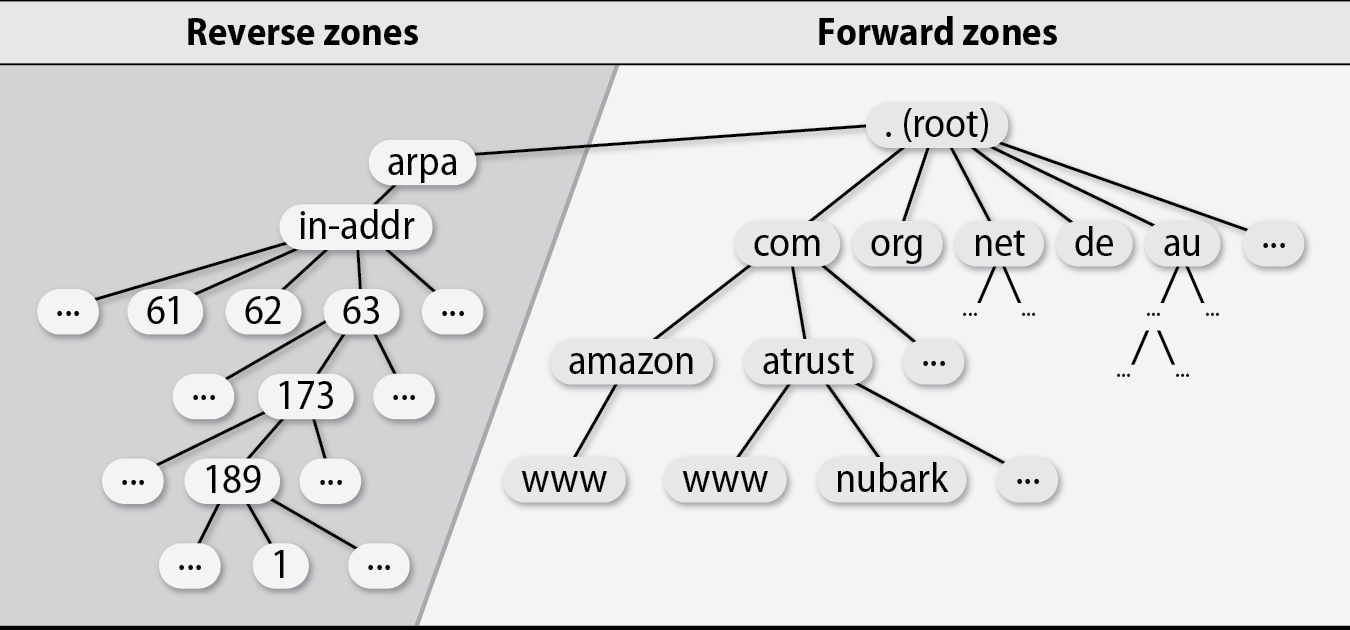
Question
Why are IP addressses reversed?
Answer
You’ll agree if we want to search from top down for the ip
63.173.189.1we’d have to start with the most generic63and work down right?
Well we can’t just look up63so…
- We need to prepend
63.to the suffixin-addr.arpa.so it’s a fqdn (a requirement of dns queries),in-addr.arpaindicates as well to the dns server that we’re looking in a reverse zone.- Now we need to narrow down further so let’s prepend another octect to get more specific
173.63.in-addr.arpa. As you can see we’re builing the reverse record naturally, just the same as we would foratrust.com->nubard.atrust.com.
Question
What are “regular” dns records part of the “forward-zone”
Answer
hostname to address was DNS’s original primary lookup direction, “reverse” (address to hostname) was later added, making the inverse “forward”.
Question
What’s with the
.(root)
Answer
.means it’s a FQDN, in a similar way is relativehome/matand/home/matis absolute. It just tells the dns server to start at the top when searching for the corresponding record.
Hows DNS works
Name servers
Definition
Zone: Nameservers have an abstraction called zone, which is the unit of DNS delegation and administration
| Type | Authoritative | Purpose |
|---|---|---|
| Primary | ✓ | Holds zone data; editable source of truth |
| Secondary | ✓ | Read-only replica via zone transfer; redundancy & distribution |
| Recursive resolver | ✗ | Client-facing; walks hierarchy, caches results |
An authoritative answer from a name server is “guaranteed” to be accurate; a nonauthoritative answer might be out of date
Resource Records
A resource record (RR) is one line in a zone file: name TTL class type rdata. It maps a DNS name to some data — an IP, a mail server, a canonical name, etc. Type determines what rdata means.
Caching
A cached answer is almost free and is usually correct because hostname-to-address mappings change infrequently.
An answer is saved for a period of time called the “time to live” (TTL), which is specified by the owner of the data record in question.
Tools for debugging
# Simplier and pretty output
nslookup
host
# More details
dig
drill
delv # as in delve deeper than dig
dig
dig +trace docs.pawney.net
dig @192.168.2.1 docs.pawney.net # force a ns with @
parsing the output
Header
# NOERROR = no notable error
;; ->>HEADER<<- opcode: QUERY, status: NOERROR, id: 16620
# NXDOMAIN = requested name doesn't exist
;; ->>HEADER<<- opcode: QUERY, status: NXDOMAIN, id: 6134
Answer section
# the answer field is the actual response which resolves the hostname to an ip
;; ANSWER SECTION:
docs.pawney.net.        282     IN      A       172.64.80.1
The DNS Database
Resource Records
Basic format of a resource record
[name] [ttl] [class] type data

# special characters in resource records
;  # comment
@  # the current zone name
() # allow data to span lines
*  # wild card (name field only)
A name can be either relative or absolute. Absolute names end with a dot and are complete. Internally, the software deals only with absolute names; it appends the current origin and a dot to any name that does not already end in a dot. This feature allows names to be shorter, but it also invites mistakes.
The ttl (time to live) field specifies the length of time, in seconds, that the record can be cached and still be considered valid
| Category | Type | Name | RFC | Function |
|---|---|---|---|---|
| Zone | SOA | Start of Authority | RFC 1035 | defines a DNS zone |
| NS | Name Server | RFC 1035 | identifies servers, delegates subdomains | |
| Basics | A | IPv4 Address | RFC 1035 | hostname to ipv4 |
| AAAA | IPv6 Address | RFC 3596 | hostname to ipv6 | |
| PTR | Pointer | RFC 1035 | ip to `hostname | |
| MX | Mail Exchanger | RFC 1035 | Controls email routing | |
| Optional | CNAME | Canonical Name | RFC 1035 | Nicknames for a host |
| SRV | Service | RFC 2782 | Gives locations of a well-known service | |
| TXT | Text | RFC 1035 | Comments or untyped information |
- By convention, SOA record comes first, followed by NS records
- Records for each host are typically grouped together
- Common to sort by name field; some sites sort by IP address instead (makes unused addresses easier to spot)
Gotchas with records Records
Question
What’s the point in MX records, when A records also map hostname to IP
Answer
MX adds priority values and redudancy which plain A records have no way to express
example.com.  MX  10  mail1.example.com.
example.com.  MX  20  mail2.example.com. # mx allows a fallback here and maps the A records
mail1.example.com.  A  203.0.113.10
mail2.example.com.  A  203.0.113.20
Note: this only works for SMTP clients, no other software will try to use the MX record as a client
SRV records
SRV records are a general version of what MX records do. They let you listen and route to different hosts based on priorities. In otherworths it’s like CNAME load balancing.
example
# contrived example of two ssh servers
_ssh._tcp.example.com.  300  IN  SRV  10 60 22 ssh1.example.com.
_ssh._tcp.example.com.  300  IN  SRV  10 40 22 ssh2.example.com.
dig _ssh._tcp.example.com SRV # then client could ssh to the reponse
DNS Server (resolver) Security
DNSSEC
DNSSEC validation normally happens resolver <-> authoritative, not client <-> resolver. Client to server is DoT/DoH.
It’s main purpose is to ensure resolver servers lookups of records to authoritative servers are cryptographically signed and cannot be forged. If they were forged the client would get served the forged record and could be sent the wrong address.
DNS Client Security
Note
TODO! DoT/DoH